My facilitation methods
My facilitation methods are helping people to become more conflict-literate and include minority views, also those in themselves. These methods are sensory-based, using body signals to provide a more whole view of the self and the group.

Lewis Deep Democracy:
Making decisions where all voices are heard
Imagine you’re in a group — a team, a family, a classroom — and you’re trying to make a decision. Usually, the majority wins, right?
Deep Democracy says: “Wait! What about the voices that didn’t get heard? The minority opinions? The quiet ones? The conflict bubbling under the surface?”
Lewis Deep Democracy is a practical method for:
-
Surfacing ALL voices (especially the unpopular or unspoken ones)
-
Turning tension into insight
-
Making group decisions that everyone can live with

Process Work Deep Democracy:
Radical inclusion
In Deep Democracy we believe every voice matters—not just the loud ones, not just the ones you like, but even the awkward, angry, quiet, weird, scared, or disruptive ones. This applies to your inner world (thoughts, feelings, dreams), your relationships, and groups/societies.
It invites all parts of the system, even the parts we usually ignore. Every voice (inside you or a group) is trying to bring balance, healing, and wholeness. Instead of voting parts of yourself or your community off the island—invite them to tea.
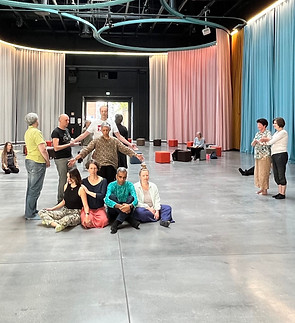
Social Presencing Theatre
What is it?
Social Presencing Theatre (SPT), developed by Arawana Hayashi as part of the Theory U framework from the Presencing Institute, includes a set of creative and embodied “tools” or practices that help individuals and groups understand social systems more deeply and sense what wants to emerge or shift.
Stuck Exercise
You embody a situation where something feels stuck — maybe at work, in a relationship, or in society. You create a still posture (a “sculpture”) that represents how it feels.

Theory U
What is it?
Theory U is a framework for deep change and innovation — in individuals, organizations, or systems — developed by Otto Scharmer at MIT. Imagine it as a U-shaped journey that helps people and teams move from reacting to problems with old habits, to co-creating solutions from a deeper understanding of the future that wants to emerge.
Tell us how you feel about us
Want to share something about your experience with us? We'd love to hear it!